You notice the change before you see it. Somewhere past Hassan the air thickens, the light goes green, and the road starts climbing between walls of vegetation that close over the top. That’s the Sakleshpur rainforestannouncing itself, and it behaves nothing like the tidy hill stations most people picture when they book a weekend away. Streamedge Sakleshpur offers a comfortable nature-focused base for travellers exploring this landscape, while Streamedge Sakleshpur can be considered when planning a relaxed Western Ghats getaway.
What Makes the Sakleshpur Rainforest Different
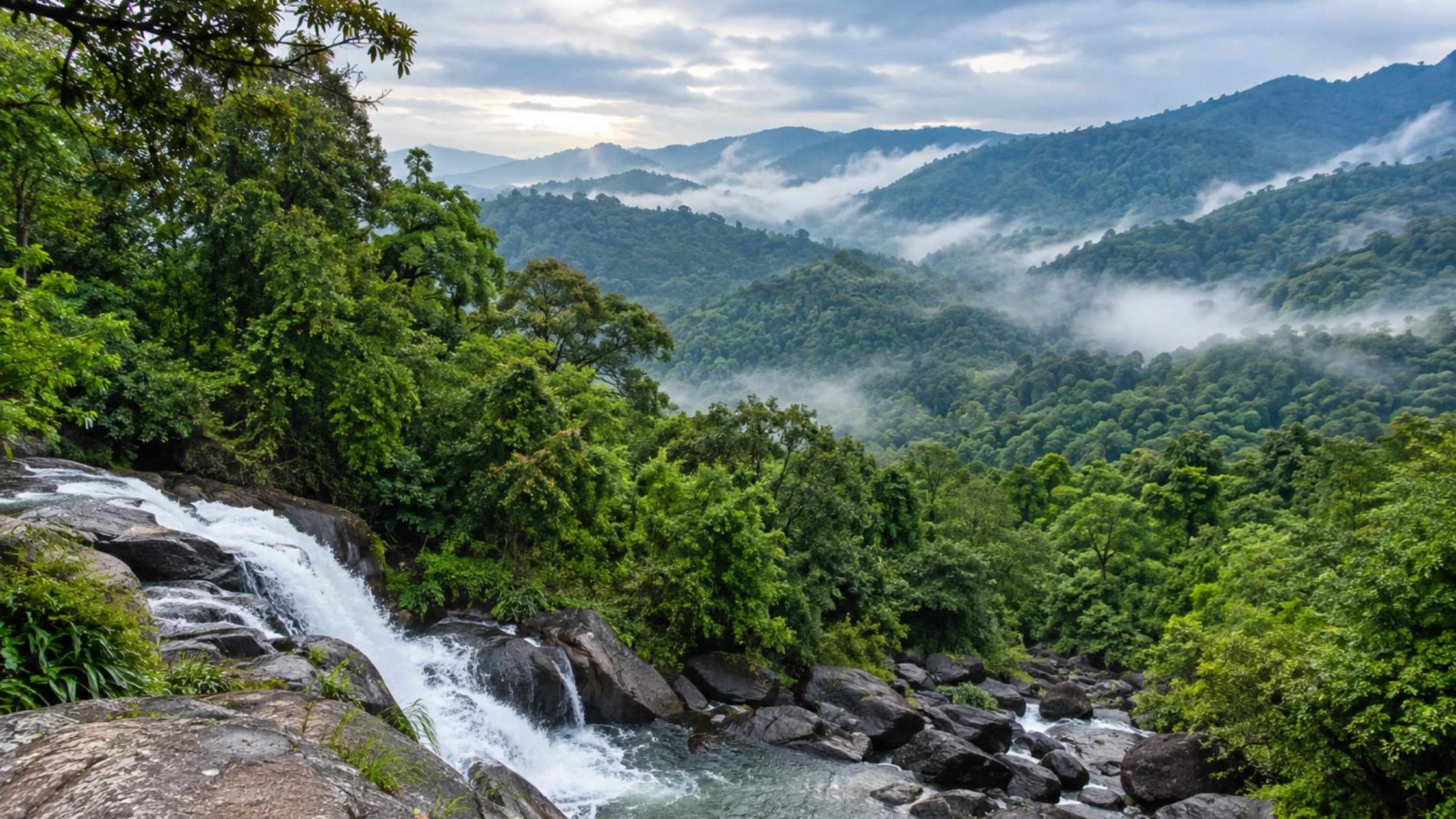
Sakleshpur sits at roughly 900 metres, on the crest where the Western Ghats break the southwest monsoon. Rainfall here runs heavy and long, and in the wettest pockets towards Bisle it comfortably exceeds most of Karnataka. That water is what produces the forest structure: tall evergreens with buttressed roots, a dense understorey, epiphytes on every branch, and streams that never fully dry.
Two things follow from that. First, the Sakleshpur rainforest is not one continuous block. Decades of coffee planting have cut it into a mosaic of protected patches, reserve forest, private estates and secondary regrowth. Second, the shade-grown coffee estates function as partial habitat themselves, since most retain silver oak and native shade trees that birds and small mammals still use.
That mosaic is why your experience varies so much with where you stand. Ten minutes apart you can be in open estate land or genuinely closed canopy.
The Western Ghats Near Sakleshpur: Reading the Landscape
Elevation and rainfall
Along the Bisle Ghat road, elevation drops fast towards the Kumaradhara valley and the Sakleshpur rainforest gets denser as you descend. The Western Ghats near Sakleshpur are steepest on this western face, which is why viewpoints look out over an unbroken green drop rather than gentle hills. Head east towards Hassan and the country flattens into drier plateau within about 30 km.
Coffee estates as habitat
Most land you’ll walk through is privately owned coffee. Arabica prefers the higher, cooler slopes; the hardier variety takes lower, warmer ground. Both grow under shade, so the canopy above your head may be a century old even where the crop below is not. Ask before entering any estate, because boundaries are unmarked and workers are wary of strangers during harvest.
Rainforest Places Near Sakleshpur Worth the Detour
- Bisle Ghat viewpoint looks across three ranges into the Kumaradhara valley, best in the hour after sunrise. The road down is narrow and slow.
- The Green Route rail stretch between Sakleshpur and Subrahmanya crosses tunnels and bridges cut into deep forest. Access rules change and trespassing on the line is not permitted, so check the current position locally first.
- Manjarabad Fort, star-shaped and Tipu-era, on a hilltop with 360-degree forest views, roughly 200 steps up.
- Seasonal waterfalls that only run properly from July to November, most needing a short forest walk and a local guide.
- Estate streams and small trails on private land, often the most rewarding and least crowded option.
Among all the rainforest places near Sakleshpur, the ones reached on foot beat the ones reached by car almost every time. Anything with parking has a crowd by 11 am on a Sunday, which defeats the point of coming to a rainforest.
Timing a Sakleshpur Forest Experience by Season
Monsoon: June to September
Peak intensity. Waterfalls run hard, everything is impossibly green, and rain falls for days without pause. Leeches are everywhere. Trekking gets restricted in places and visibility at viewpoints can be zero for a full day. Some travellers love the Sakleshpur rainforest exactly like this. Others cut the trip short.
Post-monsoon: October to December
The best compromise, and the window most experienced visitors pick. Streams still run, the forest stays saturated green, leech pressure drops through October, and mornings clear enough to see something from a ridge. Nights get pleasantly cold by December.
Dry season: January to May
Comfortable walking, easy roads, thin waterfalls. From February the forest looks tired and some streams stop. Bird activity picks up, which suits anyone visiting for wildlife rather than scenery. April brings coffee blossom and pre-monsoon thunderstorms.
Walking the Sakleshpur Rainforest: Leeches and Ghat Roads
Leeches surprise first-timers more than anything else in the Sakleshpur rainforest. From June to early October they’re unavoidable in wet undergrowth. They don’t hurt and don’t carry disease, but the bites bleed for a while. Wear leech socks over your trousers, tuck everything in, carry salt, and check your ankles every twenty minutes. Never pull one off mid-bite.
The ghat roads need equal respect. Hairpins on the Bisle stretch are tight, surfaces break up after every monsoon, and fog arrives within minutes. Drive in daylight, use low gears going down, and assume every blind corner has a bus in it. Coverage disappears in the valleys, so download offline maps before Hassan.
A few practical rules that hold across any Sakleshpur forest experience:
- Go with someone local for anything off a marked road.
- Start walks by 7 am and be out of the forest well before dusk.
- Carry more water than seems necessary, plus food.
- Wear shoes you can afford to soak, plus a full change of clothes in the car.
Wildlife and Nature Places in Sakleshpur: What You’ll Actually See
Set expectations honestly. Elephants move through the corridors between Bisle and Pushpagiri and leopards are present, but you’re unlikely to see either from a trail in one weekend. What the Sakleshpur rainforest reliably gives you is smaller and often better: Malabar giant squirrels crashing between branches, giant wood spiders across paths, frogs calling through monsoon nights, and birds found nowhere outside this range.
Thebest nature places in Sakleshpur for sightings are estate edges at first light, where forest meets open ground. Sit still for forty minutes near a stream and you’ll do better than walking five kilometres. Guides who grew up on these estates know which bends hold what.
Where to Stay: Nature Resorts Near Sakleshpur
| Stay type | Indicative rate per night (two adults) | Best for |
| Estate homestay, basic rooms | Rs 2,000 to Rs 3,500 including meals | Walkers, budget travellers |
| Plantation cottage or bungalow | Rs 4,000 to Rs 7,500 | Couples wanting quiet and privacy |
| Full-service nature resort | Rs 5,500 to Rs 12,000 | Families, groups, corporate offsites |
| Tented or camp stay | Rs 1,500 to Rs 3,000 per head | Younger groups, short trips |
Rates climb 30 to 50 percent over long weekends and the year-end fortnight. When comparing nature resorts near Sakleshpur, ask how far the property sits from the main road, whether it holds genuine Sakleshpur rainforest or just landscaped garden, whether guided walks are included, and what the backup power arrangement is. Monsoon outages are routine.
Frequently Asked Questions
Is the Sakleshpur rainforest safe to visit during monsoon?
Generally yes, with care. Roads stay open, but landslides occasionally close ghat sections and river crossings turn dangerous after heavy rain. Avoid waterfalls at full flow, don’t trek without a guide, and keep your plans flexible. Check local conditions on the morning you travel rather than trusting a forecast.
How many days do I need in the Sakleshpur rainforest?
Two nights is the practical minimum, giving one full day for a morning walk and an afternoon viewpoint. Three nights covers Bisle Ghat, a longer trek and a slow estate day without rushing. Single-night trips lose most of their hours to the five-hour drive each way.
Can I trek independently without a guide?
Not sensibly. Trails are unmarked, land boundaries are invisible, and fog disorients people quickly. Some routes need permission from the forest department or the estate owner. A local guide typically costs a few hundred rupees for a half-day walk and greatly improves what you actually see.
What should I pack for rainforest weather?
Quick-dry clothing, leech socks, a rain jacket rather than an umbrella, shoes with grip, a torch and a dry bag for electronics. Add repellent, basic first aid and warm layers for December and January nights, which can drop into single digits.
Conclusion
The Sakleshpur rainforest rewards visitors who accept it on its own terms. It’s wet, uncomfortable in parts, and won’t hand you a clear panorama just because you drove five hours for one. What it offers is an old, layered forest a few hours from Bengaluru, where a morning walk can produce hornbills overhead and a stream nobody else has photographed. Streamedge Sakleshpur can provide a comfortable base for exploring the region while keeping your stay connected to nature. Pick October or November for the best balance, go with someone who knows the ground, and build the trip around walking rather than driving between viewpoints. Two nights, decent boots and a bit of patience are genuinely all it takes. Streamedge Sakleshpur can also be considered when you want to combine rainforest exploration with a relaxed stay.
Planning your Sakleshpur rainforest getaway? Contact Streamedge Sakleshpurto check availability, stay options and booking details for your preferred dates.
Follow us on Instagram for more Sakleshpur nature experiences, resort updates and Western Ghats travel inspiration.


