The mist here does not behave. You set up at a viewpoint expecting layered ridges, and four minutes later you’re photographing a white wall. Then it clears completely. Most Sakleshpur photography spots reward the person who waits rather than the person with the better lens, and that single habit changes more results than any equipment upgrade. Streamedge Sakleshpur offers a nature-focused base for photographers exploring the region, while Streamedge Sakleshpur can be considered when planning a comfortable stay close to Sakleshpur’s scenic landscapes.
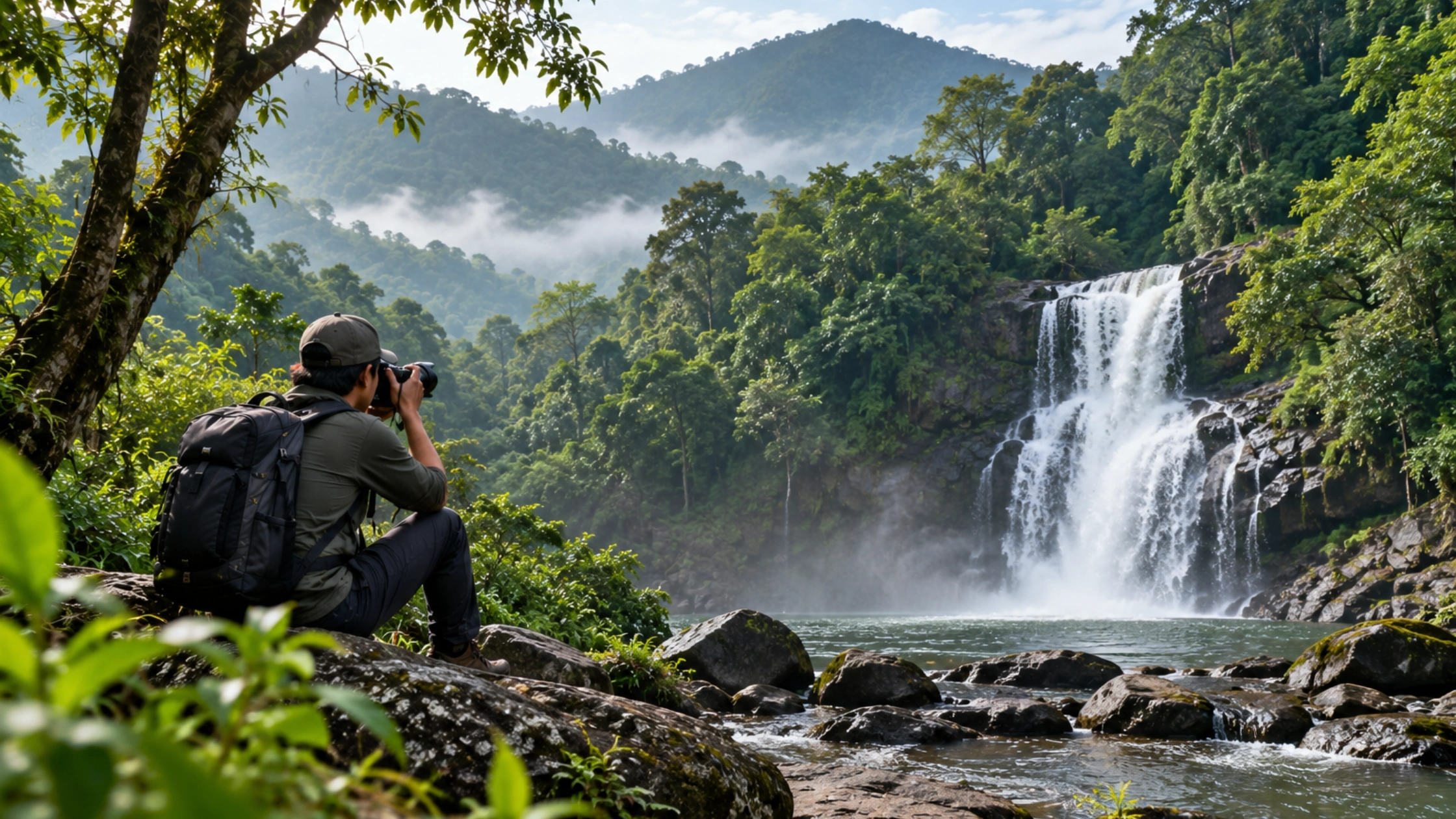
Why Sakleshpur Photography Spots Suit Nature Work
Three things stack up in your favour. Elevation gives layered ridgelines that separate beautifully in haze. Moisture generates cloud and mist almost daily for half the year. The shade-coffee landscape means old trees, textured bark, epiphytes and filtered light rather than open farmland.
The trade-off is contrast. Under heavy overcast the forest goes flat and green in a way that kills files. Under harsh midday sun the dynamic range between canopy and shadow is brutal. Your usable windows are narrow, which is why local knowledge about Sakleshpur photography spots beats driving to whatever appears first in a search result.
The Light: How Season Shapes Every Frame
Monsoon, June to September
Dramatic and frustrating in equal measure. Waterfalls run full, everything is saturated, and you’ll spend hours with gear under a poncho. Bring silica, microfibre and a real rain cover. Expect flat light most of the day with brief spectacular breaks.
Post-monsoon, October to December
The best period for most photographers. Mornings deliver valley fog that burns off around nine, skies have structure, and the greens are deep without being sodden. If you can only make one trip to the Sakleshpur photography spots, make it this one.
January to May
Cleaner air, longer evenings, gold in the grass by March. Waterfalls thin and the landscape loses drama, but wildlife and macro come into their own, and you can shoot late without a downpour.
Sakleshpur Photography Spots Worth Building a Day Around
| Location | Best light | What to bring | Notes |
| Bisle Ghat viewpoint | Sunrise to 8 am | 24-70mm, 70-200mm | Layered ridges over Kumaradhara; cloud fills fast |
| Manjarabad Fort | Late afternoon | Wide angle, drone where permitted | Star-shaped plan needs elevation to read properly |
| Estate roads and coffee blocks | First and last hour | 35mm, 85mm | Drying yards, texture, figures |
| Seasonal waterfalls | Overcast midday | ND filter, tripod | Slippery rock, spray on the front element |
| Ridge tops near town | Blue hour | Fast prime, tripod | Village lights and mist pooling in valleys |
Among the scenic places in Sakleshpur, roadside viewpoints get crowded by mid-morning at weekends, so treat them as sunrise locations only. The quieter photography spots in Sakleshpursit on estate land, which means asking permission or staying somewhere that grants access.
Landscape Photography Sakleshpur: Working With a Green Monotone
The commonest complaint from first-timers at Sakleshpur photography spots is that everything records as one undifferentiated green. That’s a composition problem more than a colour problem, and it has practical fixes.
- Use atmosphere as your separator. Ridges only read as distinct planes when haze sits between them, which is why the hour after sunrise matters.
- Find a hard element. A tiled roof, a red mud track, a person in a bright saree. One non-green anchor rescues a frame.
- Shoot long, not just wide. A 70-200mm compressing three ridgelines usually beats a wide shot with an empty sky in it.
- Watch your white balance. Under canopy it drifts cool and green together. Shoot raw and set it deliberately.
Landscape photography Sakleshpur style rewards restraint. The temptation is to include everything because the view is enormous. The frames that hold up are the ones where you removed two-thirds of it.
Nature Photography in Sakleshpur: Wildlife, Macro and Detail
Large mammals are present but rarely photographable on a short trip, so aim at what the habitat actually delivers. Malabar giant squirrels, hornbills, drongos and barbets are realistic with a 400mm or a 100-400 zoom. Frogs, fungi, spiders and insects are outstanding, particularly in monsoon and just after.
Macro deserves more attention than most visitors give it. A 100mm macro plus a diffused flash turns a wet evening on an estate path into a productive session, and a good nature photography in Sakleshpurportfolio often ends up more macro than vista. Work slowly and never reposition a living subject for a cleaner background.
Gear That Earns Its Weight
- Weather sealing above all. Humidity gets into everything. Carry a dry bag, silica sachets and a spare microfibre in each pocket.
- A tripod you’ll actually use. Waterfalls, blue hour and forest work need one. Rubber feet grip wet rock better than spikes.
- Two zooms rather than five primes. A 24-70 and a 70-200 cover most Sakleshpur photography spots without lens changes in damp air.
- Polariser and ND. The polariser cuts glare off wet leaves, which alone justifies the weight.
- Power and storage. Estate outages are routine in monsoon, so charge overnight and carry spare cards.
Leave the heaviest kit in the car on exploratory walks. You’ll cover more ground, and covered ground is what finds new frames.
Access, Timing and Permissions
Most of the land holding the best photography spots in Sakleshpur is privately owned coffee. Walking in unannounced is rude and, during harvest, disruptive. Ask through your host and expect a yes more often than not.
Drone rules deserve care. Restrictions vary by location and change over time, so check current regulations and get the landowner’s explicit permission before flying. Some viewpoints and heritage sites prohibit it outright.
Ghat roads add constraints. Fog cuts visibility to a few metres in minutes, so avoid driving mountain sections after dark while chasing a sunset. Add forty minutes to every leg and you’ll stop making bad decisions about light.
Scenic Resorts in Sakleshpur: Picking a Base You Can Shoot From
Your accommodation is a location, not just a bed. Some of the best Sakleshpur photography spots sit within 500 metres of where you slept, at an hour when nobody wants to drive.
Indicative rates run from about Rs 2,000 to Rs 3,500 a night for a simple estate homestay with meals, Rs 4,000 to Rs 7,500 for a plantation cottage and Rs 5,500 to Rs 12,000 for a full-service property, with long weekends higher. When comparingscenic resorts in Sakleshpur, ask which way the property faces at sunrise, whether it sits on a ridge or in a bowl, how far the nearest forest patch is on foot, and whether staff can manage coffee at 5.30 am. That last one matters more than the décor.
Frequently Asked Questions
When is the best time to shoot Sakleshpur photography spots?
October to December is the strongest window, with valley fog at sunrise, structured skies and deep greens. June to September gives dramatic waterfalls but constant rain and flat light. February to May suits wildlife, macro and evening work. Whatever month you pick, the two hours after sunrise carry most of the good light.
Do I need permission to photograph on coffee estates?
Yes, for anything beyond public roads. Estates are private working farms, and harvest makes owners understandably cautious about strangers. Ask through your homestay, explain that you’re photographing landscape or wildlife rather than people at work, and most owners will point you towards their better viewpoints.
Can I fly a drone at scenic places in Sakleshpur?
Sometimes, but never assume. Rules depend on the specific location and on current national regulations, and some heritage structures prohibit drones entirely. Confirm the present position and get the landowner’s consent first. Flying without permission risks confiscation and sours access for photographers who come after you.
Is a phone camera enough for a first trip?
For wide scenic frames, honestly yes. Modern phones handle layered ridges and mist surprisingly well, especially shooting raw. They fall short in low light under canopy, on distant wildlife and on macro detail. If you’re carrying one camera, a mid-range body with a 24-105mm covers most Sakleshpur photography spots comfortably.
Conclusion
The strongest Sakleshpur photography spots aren’t secrets, they’re just badly timed by most visitors. Get to the viewpoint before the light does, stay after the crowd leaves, and spend the middle hours working macro and detail instead of forcing landscapes under a flat cloud. Streamedge Sakleshpur can provide a comfortable base that keeps photographers close to the natural surroundings while allowing time to plan early shoots. Choose a base that puts you somewhere useful at dawn, respect the fact that this scenery belongs to working farms, and accept that at least one morning will be a whiteout. The ones that do clear, when fog peels off three ridgelines in sequence, more than make up for it. Streamedge Sakleshpur can also be considered when you want to combine photography-focused days with a relaxed stay.
Planning a photography getaway in Sakleshpur?Contact Streamedge Sakleshpurto check stay availability, booking options and arrangements for your preferred dates.
Follow us on Instagram for more Sakleshpur photography inspiration, scenic locations, resort updates and travel ideas.


